Why Execution Keeps Routing Back to Founders as Teams Grow
Execution Breakdowns
8 Min Read
Most founders try to escape daily execution by buying tools, hiring seniors, or adding processes. None of it works. Because the problem isn't effort or investment—it's misalignment. When Purpose, People, Priorities, and Progress aren't aligned, execution will always route back to you. Here's how to fix it.
You built your business over years. Twenty years, maybe more. It survived. It grew. Revenue is decent. From the outside, everything looks stable.
But you know the truth.
The business runs only because you are always involved. Client escalations come to you. Budget decisions wait for you. Priority questions land on your desk. When deadlines slip, you step in.
You are not managing the business anymore. You are holding it together.
This is not what you signed up for. You wanted growth. You wanted a team that could execute. You wanted to focus on the future, not firefight the present. But somehow, as the team grew, so did your involvement. More people did not mean less dependency. It meant more.
And you are exhausted.
Not from the work itself. From being the answer to everything.
The Problem: Growth That Traps Instead of Frees
Here is the strange part. You did what you were supposed to do.
You hired good people. You bought tools to manage work better. You ran performance reviews. You sent people to training programs. You tried to delegate. You even set up processes.
And still, nothing moves unless you are involved.
Research shows this is not rare. According to a study published in 2024 by entrepreneur mental health researchers, 42% of business owners have experienced burnout in the past month, and 24% are currently experiencing burnout. Another survey found that 42% of small business owners have experienced burnout in the past year, with 56% feeling like they are completely alone in solving problems.
You are not failing. You are stuck in a pattern that traps most businesses at a certain size.
The pattern works like this. When you had five people, everyone understood what mattered. Conversations were short. Adjustments happened quickly. Everyone stayed close to the purpose.
At twenty people, understanding fragments. At fifty people, it disappears. According to research from the Institute for Public Relations, while employees feel they understand their organization's core purpose, organizations fail to provide clear line-of-sight on strategy and priorities.
So people start asking you. What is the priority? What should we focus on? Should we do this or that?
You answer. Because if you do not, nothing happens.
Then you hire more people. You think more hands will lighten the load. But each new person needs the same answers. The same clarity. The same direction.
Except now you have thirty people asking. Then forty. Then fifty.
You become the hub. Every decision flows through you. Every confusion gets escalated to you. You thought you were building a team. You were actually building a dependency system.
And tools do not fix this.
You bought software to track work. Everything looks organized on the dashboard. Tasks are color-coded. Deadlines are visible. But the team still asks what matters most. Because tools track activity. They do not define outcomes. Leadership communication research shows that only 45% of employees understand what is expected of them at work.
You hired experienced managers. Strong backgrounds. Industry knowledge. You thought they would take ownership. They drift. They wait for direction. They escalate decisions back to you.
Not because they lack ability. Because roles were never clearly defined. Deloitte research reveals that only 30-40% of companies effectively align job titles and roles with the actual work being performed.
You formalized everything. Performance reviews. Standard operating procedures. Quarterly planning. Forms were filled. Meetings were held. Nothing changed.
Because process records confusion. It does not remove it.
The Real Cost of Being the Bottleneck
This does not just slow things down. It creates damage that compounds quietly over time.
Your team learns to wait. When every decision requires your input, people stop thinking. They stop taking initiative. They escalate instead of solving. You thought you were maintaining standards. You were training helplessness.
Your best people leave first. High performers do not stay in systems where ownership is unclear. They want to build something. They want their work to matter. When structure is missing, they drift.
Gallup research indicates that only 47% of employees strongly agree they know what is expected of them. You lose good people not to better salaries. You lose them to vague expectations.
Growth starts to feel dangerous instead of exciting. Every new client adds complexity. Every new hire creates more coordination needs. Every new project requires you.
McKinsey found that 63% of technology startups fail within five years, with premature scaling or lack of a clear operating model being a major contributor. But this pattern is not limited to technology. It happens in manufacturing, services, consulting, and every industry where founders get stuck holding everything together.
You work six days most weeks. Late calls. Constant interruptions. Context switching all day. You tell yourself this will pass. It has not. Because the bottleneck is not temporary overload. The bottleneck is structural.
An OnDeck survey found that 61% of small business owners take just five business days off per year, compared to workers in corporate America who take 10 days per year.
Why Substitution Does Not Work
Over the years, you tried to fix this problem.
You spent money on productivity tools. Same confusion every Monday. You paid recruitment fees to hire seniors. They left within months. You invested in coaching sessions. One good week. Then back to chaos. You ran performance reviews through HR software. Ratings stayed low. Purpose was never defined.
Each promised clarity. Each delivered activity. None removed the chaos.
This is what we call Substitution Leadership at Wisemove.
It is the belief that you can replace thinking with something you can buy. Instead of defining what success looks like, you buy tools. Instead of clarifying who owns what, you hire seniors. Instead of building structure, you motivate. Instead of removing confusion, you formalize.
Substitution feels productive. You can see the invoice. You can track the activity. You can show that you did something.
But it never fixes the system.
Because the problem was never effort. The problem was never good intentions. The problem is that clarity cannot be bought. It has to be built.
The Same Page Framework
After working with founders stuck in daily execution, we saw a pattern.
The businesses that broke free from founder dependency did not add more tools. They did not hire more people. They did not run more training sessions.
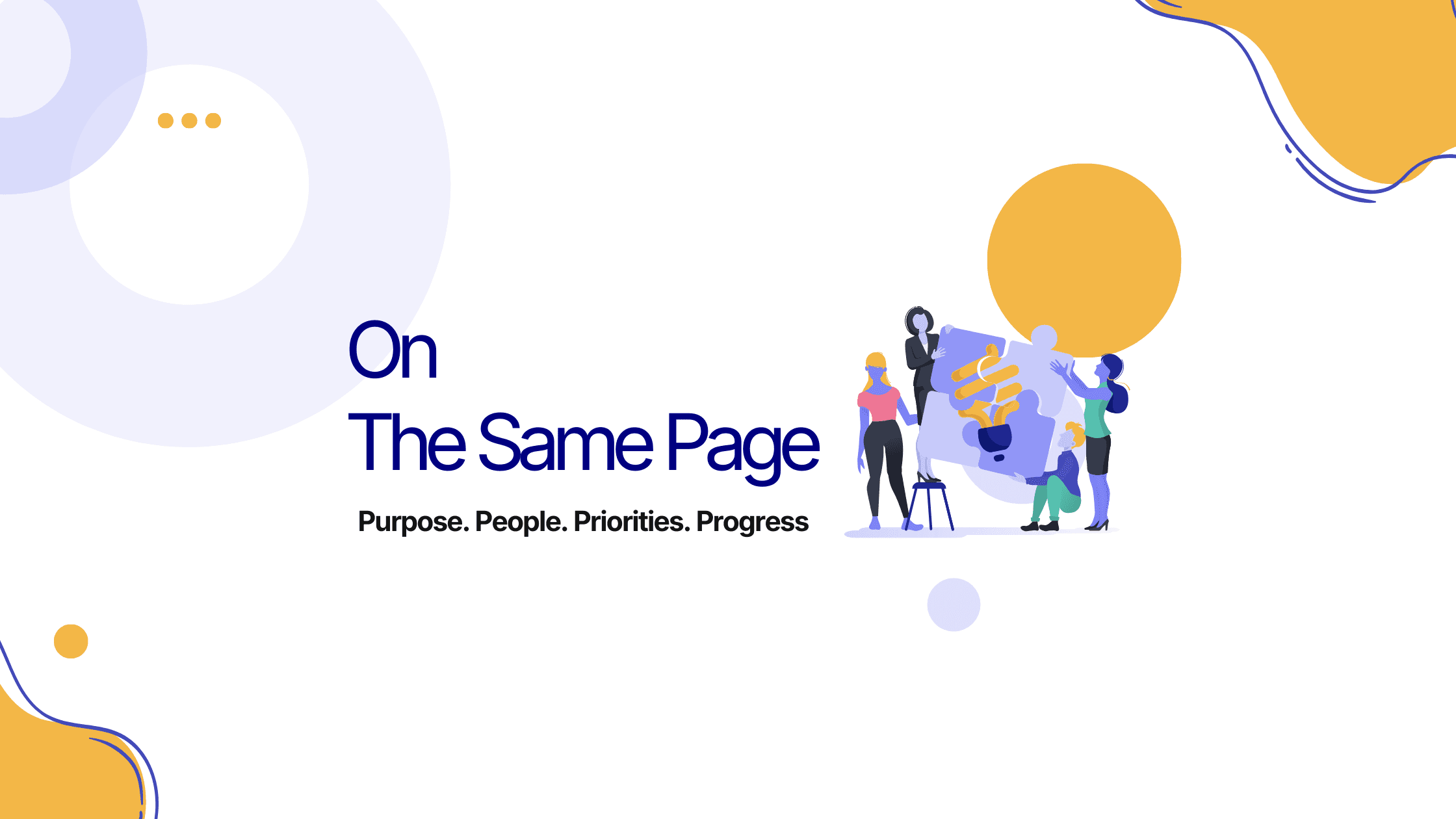
They aligned four things: Purpose. People. Priorities. Progress.
This is the Same Page Framework.
It is not a methodology to implement. It is not a new process to follow. It is how businesses that scale actually work. If these four things are not aligned, the business will always struggle. If they are aligned, execution becomes simpler.
Let me explain how.
Purpose: The Why That Holds
Purpose is not a vision statement on the wall. Purpose answers one question: why does this work matter?
When purpose is clear, teams know what they are building toward. Decisions align without constant checking. People understand how their work connects to outcomes.
Research on strategic alignment from Ethiopian universities found that clarity in the goal has significant effects on organizational performance.
Most founders communicate purpose once. At hiring. During onboarding. At the annual offsite. Then daily work takes over and purpose fades into background noise.
Without regular reinforcement, people forget why their work matters. They focus on tasks, not outcomes. They execute without understanding. And then you have to step in to remind them.
Ask yourself. Can your team explain why their current project matters? Do they know which customer problems justify the effort? Can they connect today's task to long-term outcomes?
If not, purpose is missing.
People: Roles That Define
People do not fail because they lack skills. They fail because expectations were never defined.
Organizations with strong role clarity outperform their peers financially. But most founders confuse delegation with role definition.
Delegation sounds like this: "Handle the client issue." Role definition sounds like this: "You own client retention. Success means less than 5% quarterly churn. Escalate only if a client threatens legal action or requests services outside our scope."
The first creates temporary relief. The second creates lasting ownership.
Most role confusion comes from undefined decision rights. People do not know which decisions are theirs to make. So they escalate everything to be safe. And you become the decision center.
Ask yourself. Can each person on your team describe their role in terms of outcomes, not tasks? Do they know which decisions belong to them? Do they understand what success looks like for their role this quarter?
If not, roles are unclear.
Priorities: The Few That Matter
When everything is urgent, nothing moves.
Research on organizational clarity found that employees are confident they understand their organization's purpose, but organizations fail to provide clear line-of-sight on strategy and priorities.
Most teams do not struggle because they have the wrong priorities. They struggle because they have too many priorities treated as equal.
Priority clarity means knowing the three outcomes that matter this quarter. Knowing what to stop doing, not just what to start. Knowing how to resolve conflicts when two urgent items collide.
Studies show that goal clarity positively affects team performance, and teams with higher levels of goal clarity perform better compared to teams with lower levels.
Ask yourself. Can your team name the top three priorities without looking at a document? Do they know what to say no to? Do they understand how to choose when two priorities conflict?
If not, priorities are scattered.
Progress: Visibility That Guides
Progress without visibility creates false confidence. You think things are moving until a deadline reveals they were not.
Progress clarity means knowing how to measure if you are on track, not just busy. Knowing when to check alignment, not just at quarterly reviews. Knowing what gets escalated, not everything and not nothing.
Research on alignment shows that organizations with strong alignment achieve up to double the financial performance, 58% higher operating profits, and 21% greater productivity compared to misaligned organizations.
Progress is not about dashboards. Progress is about shared understanding of where things stand.
Ask yourself. Can your team describe what "on track" looks like for their work? Do they know when to raise concerns before deadlines explode? Do they understand which metrics actually matter?
If not, progress is invisible.
What Changes When These Align
When these four things align, something shifts. Not overnight. Not through motivation speeches. Through structure that finally makes sense.
Decisions happen without you. Because roles define who decides what. Because priorities clarify which outcomes matter. Because progress visibility shows when to adjust.
Your team stops waiting. Because purpose connects daily work to long-term outcomes. Because expectations are explicit, not assumed. Because ownership is defined, not delegated temporarily.
Growth stops feeling risky. Because new people join a system, not chaos. Because complexity does not require more of your time. Because the structure scales even when you do not.
Research on scaling confirms this. Companies that invest early in operating models, management rhythm, and role clarity outperform those who treat these as afterthoughts.
The Shift Required
This does not happen by buying another tool. This does not happen by hiring another senior. This does not happen by running another training program.
This happens when you stop substituting and start defining.
Define purpose so teams know why work matters. Define roles so people own outcomes, not just tasks. Define priorities so execution has direction. Define progress so visibility guides decisions.
Research shows that strategic alignment can overcome the negative effects of strategic vagueness, and strategic clarity can overcome the negative effects of imperfectly aligned performance measures.
Clarity is not a speech. Clarity is a system.
Where to Start
If you are reading this and seeing yourself in this pattern, start here.
Step 1: Map where execution routes back to you.
For one week, track every decision that waits for you. Client escalations. Budget approvals. Priority calls. Hiring decisions. Write them all down.
Step 2: Ask why each decision needed you.
Was it because no one else had authority? Was it because roles were unclear? Was it because priorities conflicted? Was it because progress was invisible?
Most will fall into one of the four pillars.
Step 3: Define one pillar clearly.
Pick the pillar where confusion costs you most time.
If teams constantly ask what matters most, clarify Priorities. If people escalate decisions that should be theirs, define People (roles). If work happens but no one knows if it is working, fix Progress. If daily tasks feel disconnected from outcomes, anchor Purpose.
Do not try to fix all four at once. Fix one well.
Step 4: Make it visible and repeatable.
Document what you define. Share it clearly. Reference it consistently.
Alignment is not a one-time event. Alignment is a rhythm. It needs maintenance. But once the structure exists, maintaining it takes far less energy than firefighting without it.
Final Thought
The question is not whether you built something valuable. You did.
The question is whether the business can grow without depending on you for everything.
Whether your team can execute without waiting for you. Whether decisions can happen without routing through you. Whether growth feels like opportunity instead of risk.
The answer lies not in working harder. The answer lies in building a system that works without you at the center.
The Same Page Framework—Purpose, People, Priorities, Progress—is how businesses move from founder-dependent to system-driven.
Not through substitution. Through clarity.
If execution keeps routing back to you, it is not because your team lacks capability. It is because these four pillars are not aligned.
Fix that. Everything else follows.
We help founders build the clarity their businesses are missing. Not through software. Through structured thinking, guided frameworks, and real accountability. We're opening early access to founders ready to stop substituting and start defining. Interested? Request early access using the form below.
Join our newsletter list
Sign up to get the most recent blog articles in your email every week.