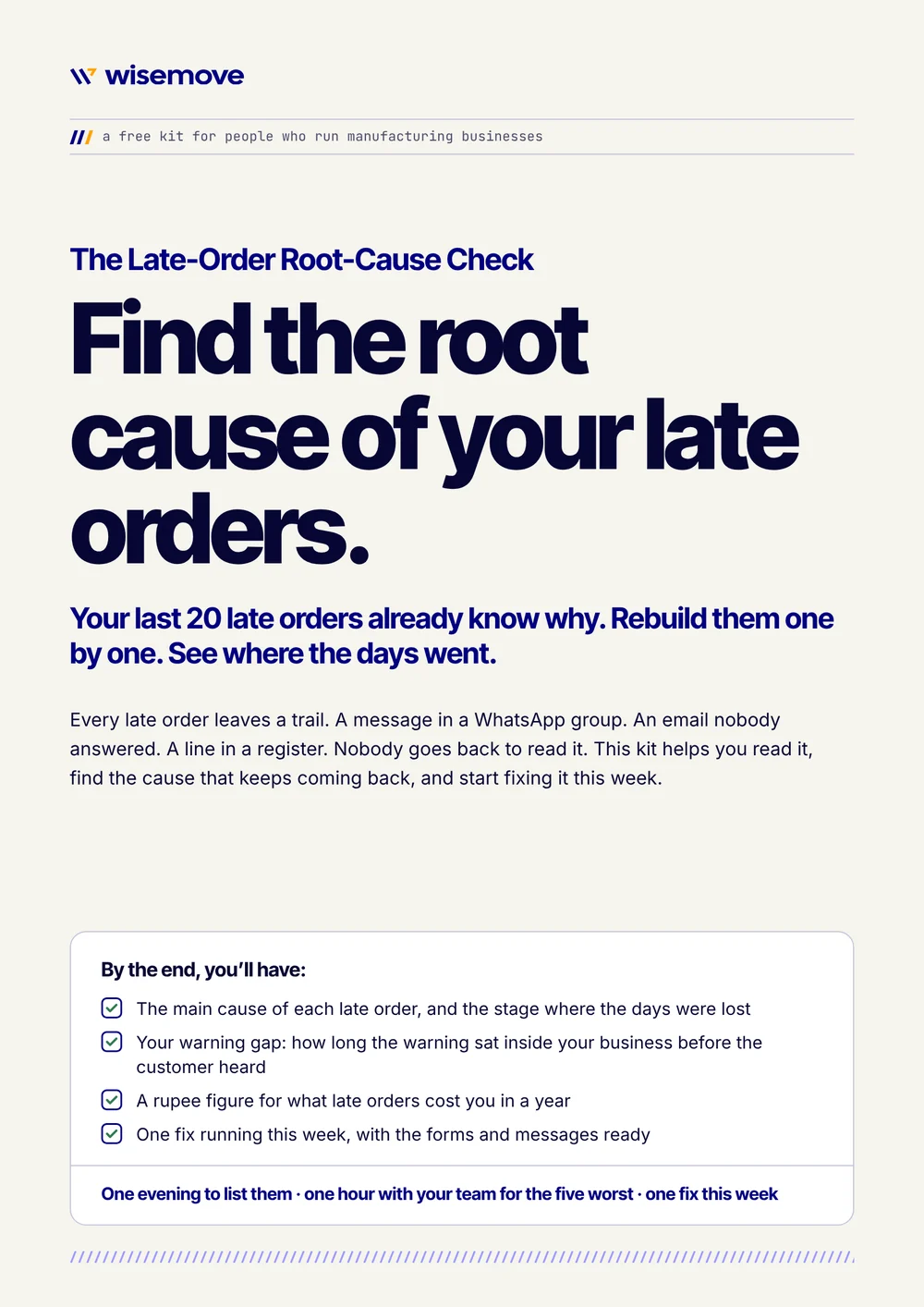
the late-order root-cause check · a free kit for people who run manufacturing businesses
Find the root cause of your late orders.
Your last 20 late orders already know why.
Every late order leaves a trail. A message in a WhatsApp group. An email nobody answered. A line in a register. Nobody goes back to read it. This free kit helps you read it, find the cause that keeps coming back, and start fixing it this week.
One evening to list them · one hour with your team · one fix this week
by the end — the cause, the warning gap, a rupee figure, one fix
By the end, you'll have:
The main cause of each late order, and the stage where the days were lost
Your warning gap: how long the warning sat inside your business before the customer heard
A rupee figure for what late orders cost you in a year
One fix running this week, with the forms and messages ready
how to use it
- 1
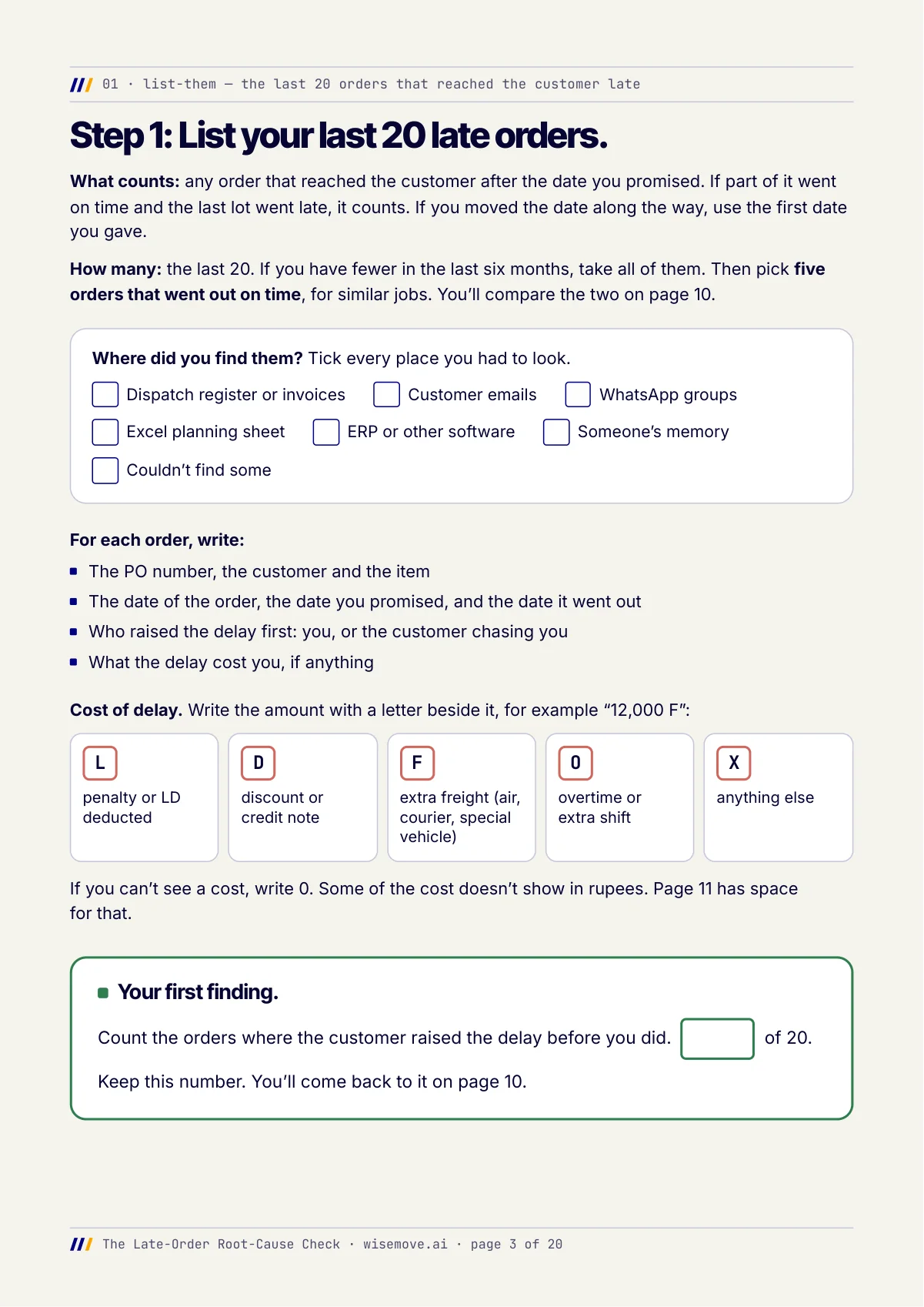
List them.
Your last 20 late orders, and five that went out on time. One evening.
- 2
Rebuild the five worst.
Sit with your team for an hour. Find where the days went.
- 3
Count.
The cause that keeps coming back, the warning gap, and the cost.
- 4
Fix one thing.
Run one fix for a week.
one hour, five orders — talk about stages, never people
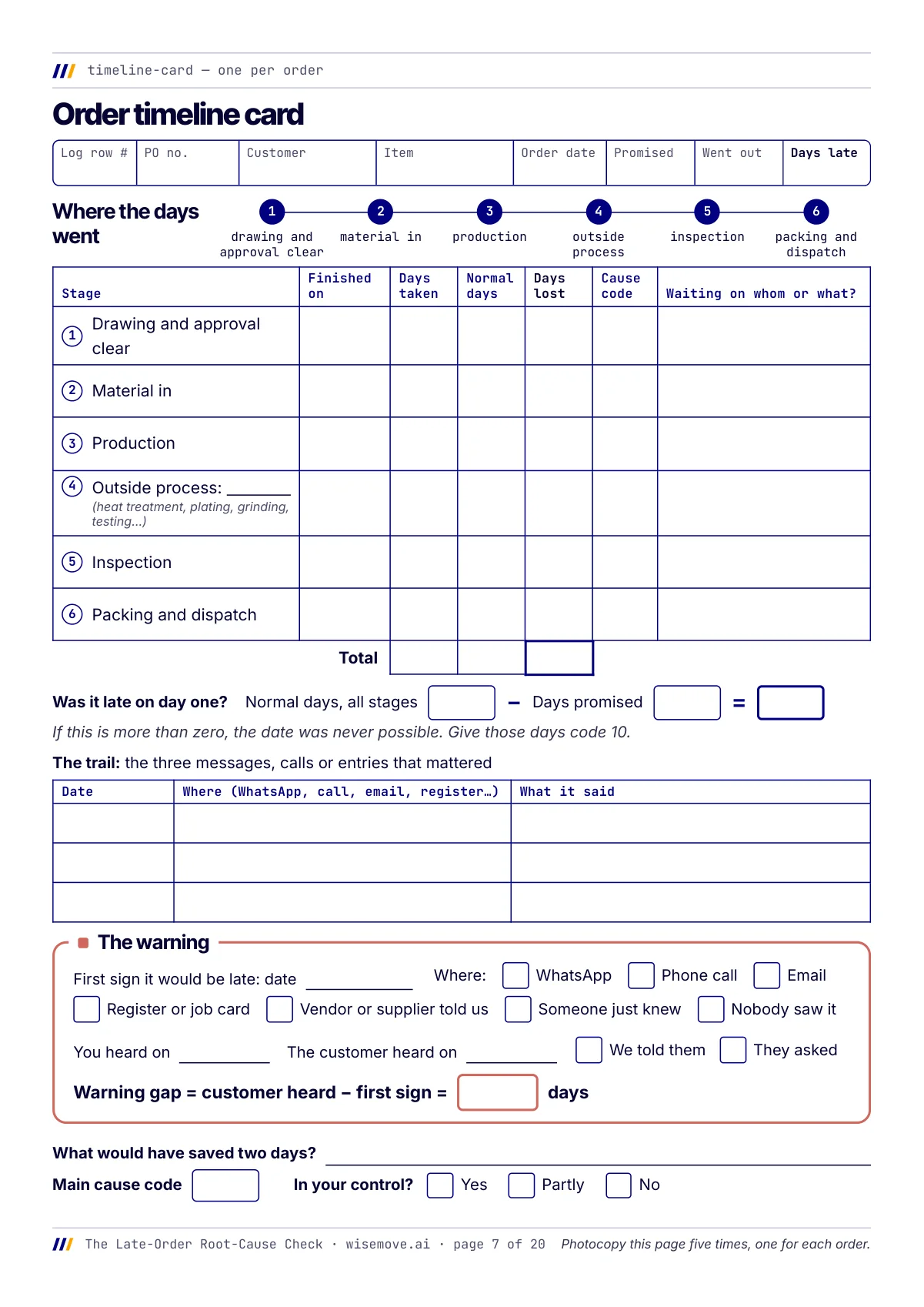
Rebuild the five worst. Ask the team five questions.
A late order can lose days at more than one stage, for more than one reason. Sit for an hour with your production head, whoever handles the customer, and whoever buys material. Bring the trail: job cards, the WhatsApp groups for those weeks, emails, registers and challans.
- 1
“When did we first know this order would be late?”
- 2
“Where did that first sign show up?”
- 3
“What were we waiting for, and from whom?”
- 4
“When did the customer hear, and who told them?”
- 5
“What would have saved two days?”
One rule: talk about stages, never people.
You're looking for where the days went. If someone feels blamed, the real story goes back into their head and stays there.
what's inside — 20 pages · 6 steps · 3 fixes
What's inside.
Six steps from your late-order list to a fix, three fixes with the forms and messages ready, and a filled-in example. Tap any part to see the page.
illustrative · a fictional company, filled in
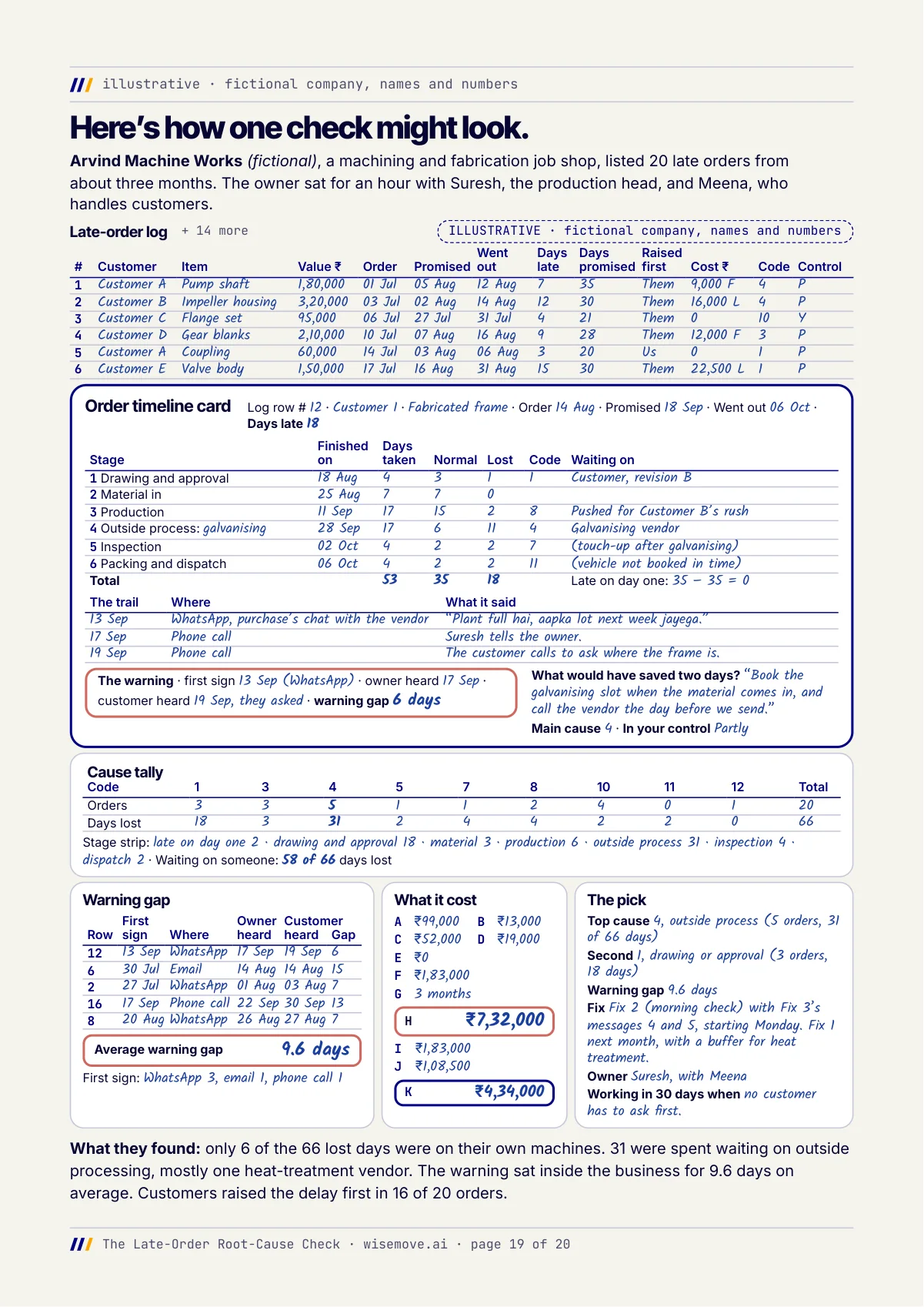
Here's how one check might look.
Arvind Machine Works (fictional), a machining and fabrication job shop, listed 20 late orders from about three months. The owner sat for an hour with Suresh, the production head, and Meena, who handles customers.
Only 6 of the 66 lost days were on their own machines. 31 were spent waiting on outside processing, mostly one heat-treatment vendor.
The warning sat inside the business for 9.6 days on average, and customers raised the delay first in 16 of 20 orders. Late orders were costing them about ₹7.3 lakh a year.
Their fix: a 10-minute morning check, with messages to the vendor and customer, starting Monday.
good to know — pen and paper is enough
the fast route, if you want it
Let AI read the trail. Your team checks every line.
Reading three months of WhatsApp groups takes time. A free AI tool can read the exports and draft a timeline for each order, with a copy-paste prompt in the kit. It only sees what was written, so calls and shop-floor talk are missing: treat it as a first draft. Use business groups only, and check the tool's data settings.
prefer a spreadsheet?
A free spreadsheet does the sums for you.
It counts days late, tallies the causes and works out the cost, then keeps running as your watch board for open orders. The link is inside the kit, so you can work on paper, on screen, or both.
get the kit — free · in your inbox in a minute
Get the Late-Order Root-Cause Check.
20 pages: a late-order log, a timeline card for the five worst, your top cause, your warning gap, a rupee figure, and three fixes you can start this week.
Already know why your orders run late? Book a call →
Long lead times often start with too many jobs open at once. Try the WIP calculator →
Is it really free?
Yes. You'll also get Samepage, our newsletter: one plain idea every Sunday for people who run manufacturing businesses. Unsubscribe any time.
Do I need any software?
No. A pen, the printed pages and your order records are enough. If you prefer, a free spreadsheet does the sums, and keeps running as your watch board afterwards. The link is inside the kit.
What if I don't have 20 late orders?
Take all the late orders from the last six months. Then pick five that went out on time, for similar jobs, so you can compare the two.
Who should sit in?
You, the production head, whoever handles the customer, and whoever buys material and sends parts for outside processing. One hour for the five worst orders.
Is this about finding who's to blame?
No. The kit has one rule: talk about stages, never people. You're looking for where the days went. If someone feels blamed, the real story goes back into their head and stays there.
Do I have to use AI?
No. The fast route is optional: a free AI tool reads your WhatsApp exports and drafts a timeline for each order, and your team checks every line. Use business groups only, and check the tool's data settings first.
What happens after I sign up?
We'll email you a link to confirm your address. Click it, and the kit is yours to download.